AROMMA: Unifying Olfactory Embeddings for Single Molecules and Mixtures

Dayoung Kang, JongWon Kim, Jiho Park, Keonseock Lee, Ji-Woong Choi, Jinhyun So
DGIST
ICASSP 2026
MY ALT TEXT

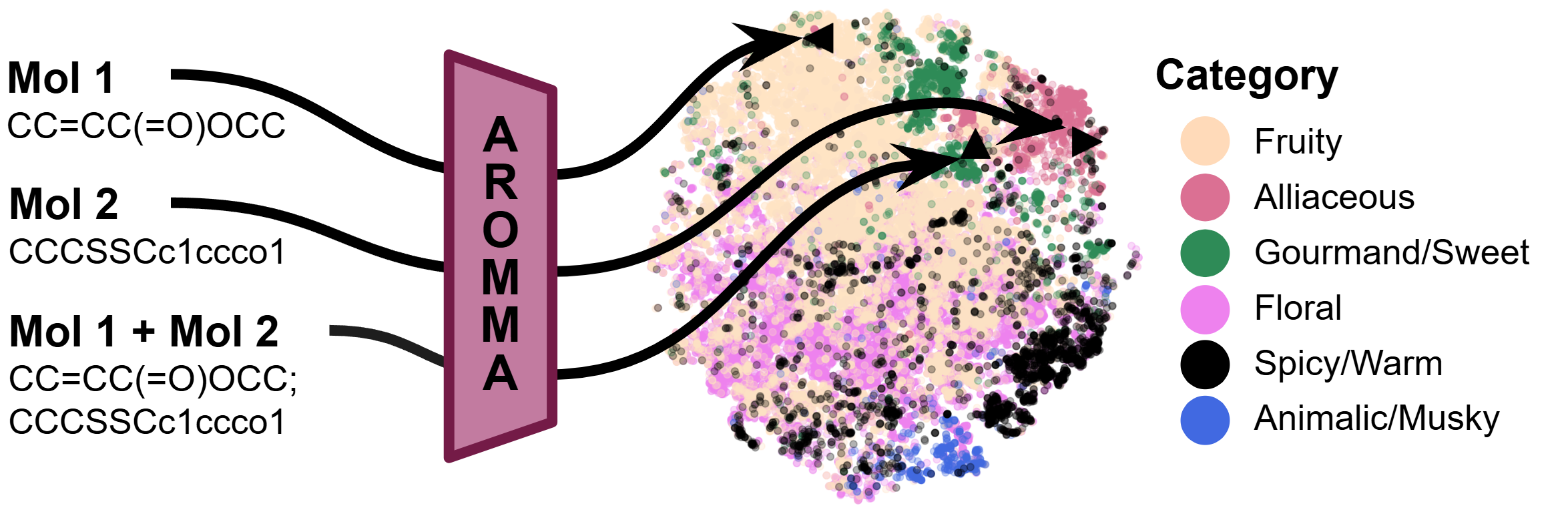
AROMMA unifies embedding space for both single molecules and binary mixtures, providing a generalized representation for olfactory perception.

Abstract

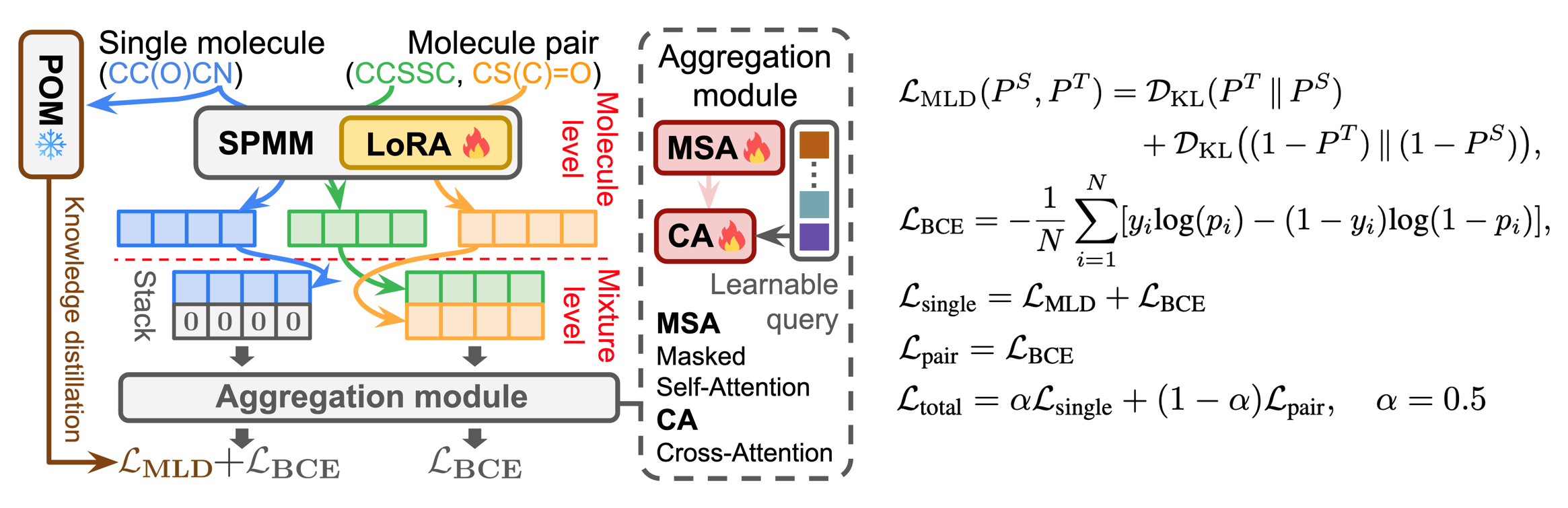
Public olfaction datasets are small and fragmented across single molecules and mixtures, limiting learning of generalizable odor representations. Recent works either learn single-molecule embeddings or address mixtures via similarity or pairwise label prediction, leaving representations separate and unaligned. In this work, we propose AROMMA, a framework that learns a unified embedding space for single molecules and two-molecule mixtures. Each molecule is encoded by a chemical foundation model and the mixtures are composed by an attention-based aggregator, ensuring both permutation invariance and asymmetric molecular interactions. We further align odor descriptor sets using knowledge distillation and class-aware pseudo-labeling to enrich missing mixture annotations. AROMMA achieves state-of-the-art performance in both single-molecule and molecule-pair datasets, with up to 19.1% AUROC improvement, demonstrating a robust generalization in two domains.
MY ALT TEXT MY ALT TEXT

AROMMA performs a multi-label classification task to predict the odor characteristics of individual molecules and molecular mixtures.

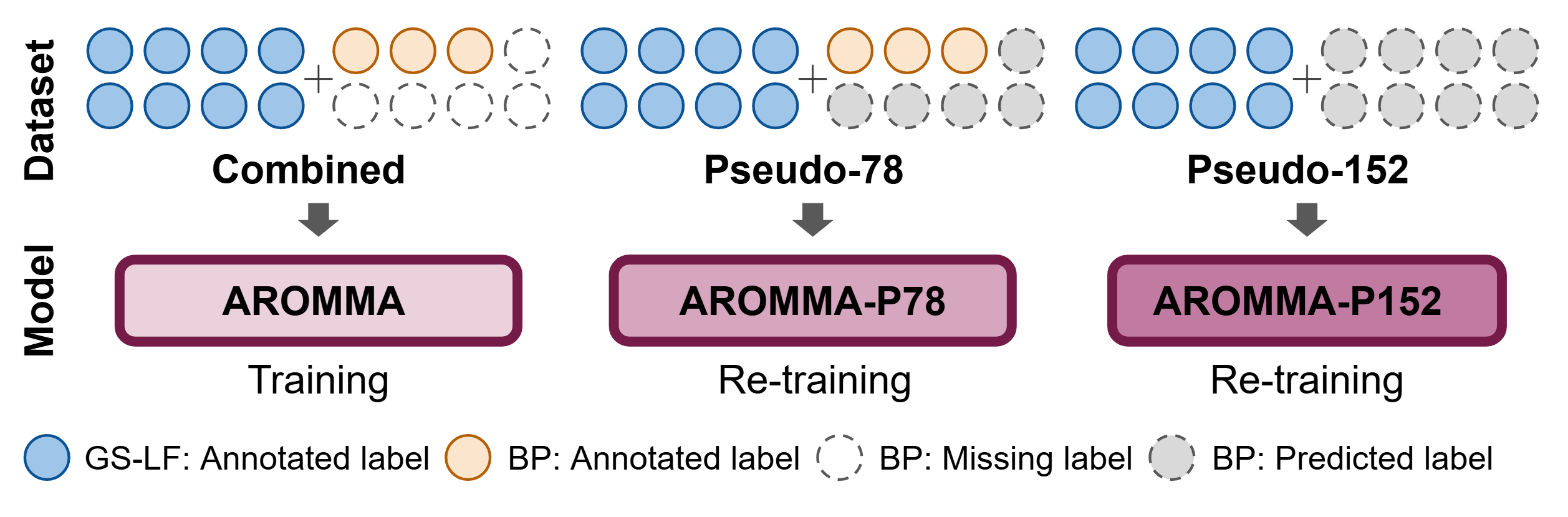
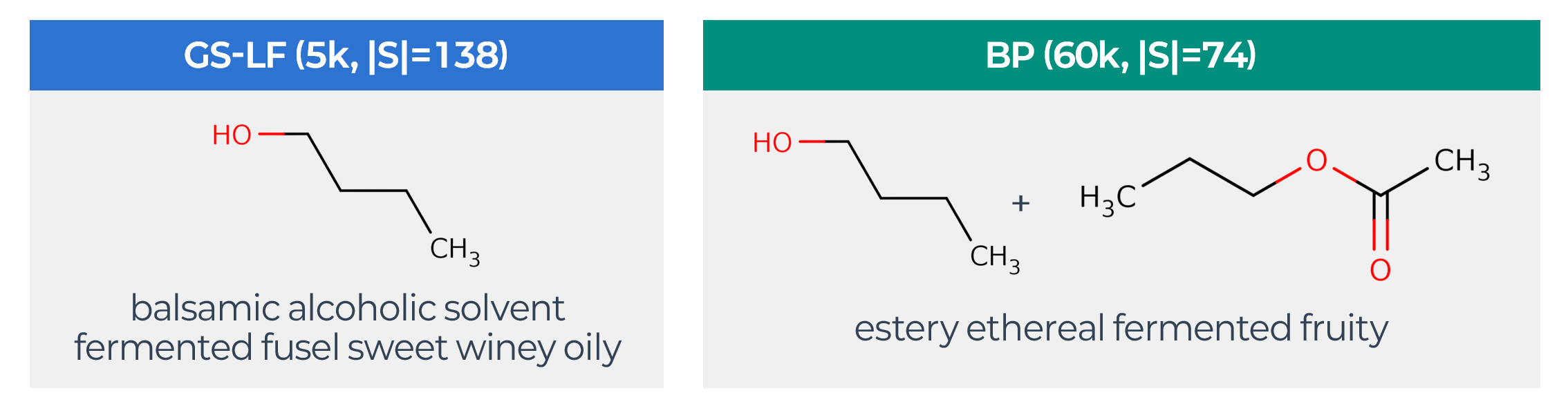
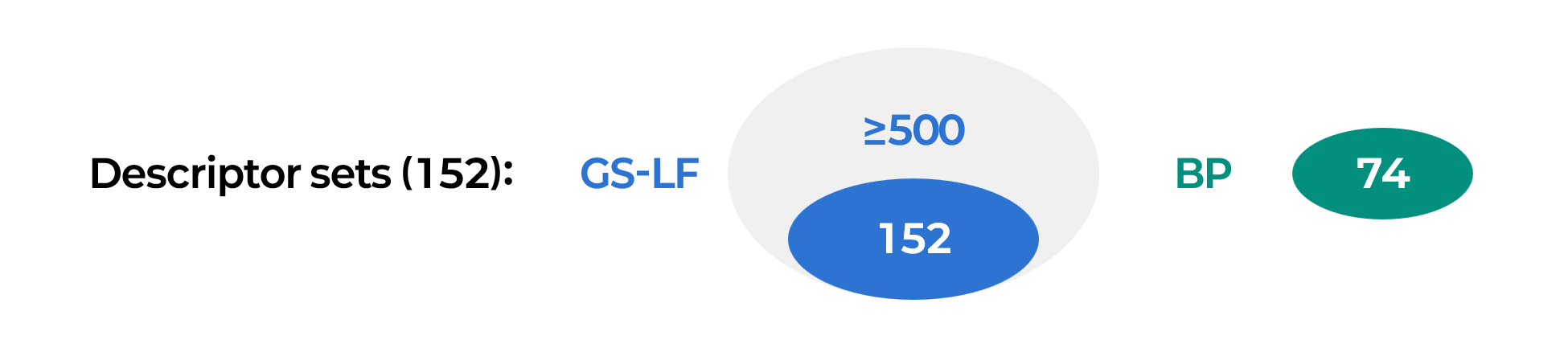
We use two datasets: GS-LF, which consists of single molecules, and BP, which contains molecular pairs. The two datasets use different odor label systems. Since all 74 odor labels used in BP are included in the original GS-LF label set, we unified the label spaces of the two datasets into a common set of 152 odor labels based on GS-LF. As a result, BP has 78 additional odor labels that are not originally annotated in the dataset, and these labels are initially filled with zeros.

MY ALT TEXT

AROMMA leverages chemical foundation model (SPMM) for robust molecular representations, incorporates an attention-based aggregator to model permutation invariance and asymmetric interactions, and addresses label sparsity through knowledge distillation and pseudo-labeling.

MY ALT TEXT

Class-aware pseudo-labeling

A key challenge in jointly training on the two datasets was the difference in label density and level of semantic granularity. GS-LF is built from expert annotations and provides relatively dense, fine-grained odor descriptions such as jasmine, rose, and lavender. Each sample contains an average of approximately 5 odor labels. In contrast, BP uses broader, category-level descriptors such as floral and is much more sparsely annotated, with only 1.4 labels per sample on average. Therefore, when the two label spaces are unified, simply assigning zeros to the unannotated BP labels may incorrectly treat potentially present odor attributes as negative labels. To address this issue and enable the model to learn richer odor representations, we adopt a label-aware pseudo-labeling and retraining strategy. First, the trained AROMMA model is used to generate predictions for the 78 odor labels that are unannotated in BP and initially filled with zeros. For each odor label, a label-specific activation threshold is then determined based on its empirical occurrence rate in GS-LF. The reconstructed BP labels are used to retrain AROMMA, thereby alleviating label sparsity in BP and reducing the representation gap between the two datasets.

MY ALT TEXT

Finding results of pseudo-labeling

AROMMA extends annotations include more fine-grained odor descriptors. E.g., blending OC1COC(Cc2ccccc2)OC1 with OCc1ccccc1 yields ground-truth labels such as floral and fruity, while our model additionally identifies rose, a descriptor within the floral category.

MY ALT TEXT

Odor prediction results of AROMMA

AROMMA achieves state-of-the-art performance on both GS-LF and BP, with pseudo-labeled data further boosting performance, highlighting the effectiveness of our approach.

Poster

BibTeX


        @inproceedings{kang2026aromma,
          title={AROMMA: unifying olfactory embeddings for single molecules and mixtures},
          author={Kang, Dayoung and Kim, JongWon and Park, Jiho and Lee, Keonseock and Choi, Ji-Woong and So, Jinhyun},
          booktitle={ICASSP 2026-2026 IEEE International Conference on Acoustics, Speech and Signal Processing (ICASSP)},
          pages={4091--4095},
          year={2026},
          organization={IEEE}
        }